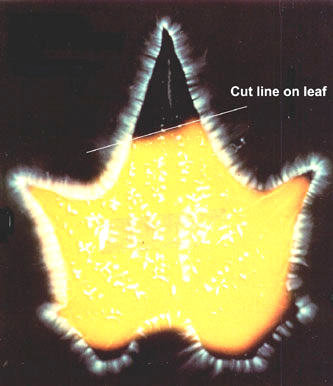
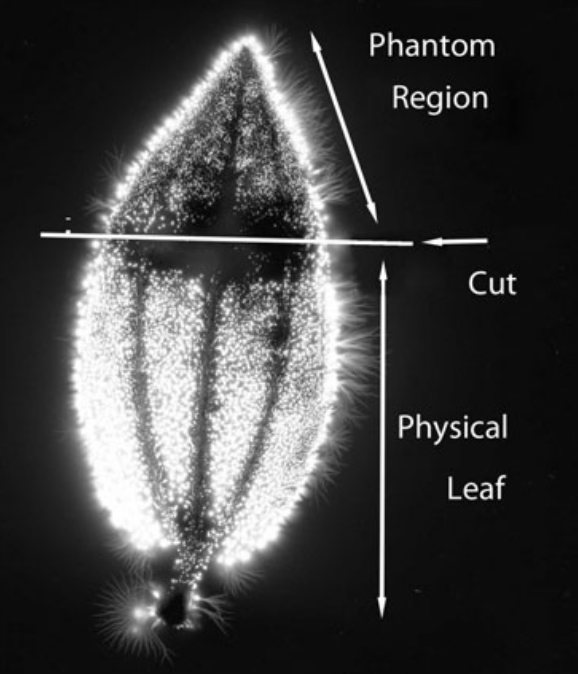
The second one http://exo-science.com/leaf3.png looks like most of what I found. It’s strange to see zero discharge at the cut and an particular at the right part of the cut that has an acute angle. Suspicious…
The other like http://exo-science.com/leaf1.png are very similar to the one in the article, but they just have too much detail on the phantom part to be real. If I have to guess, they cut the leave and put both parts on the device.
I’d wait until Mythbuster return.
I didn’t pick the name. It was used by an embryology researcher, Erich Blechschmidt, and was picked up from him by craniosacral osteopath James Jealous, for a 10-year training in gentle touch and presence to assist relaxation as you say. It is a branch of craniosacral therapy. It has nothing to do with the farming method that goes by the same name. It has actually been coined way earlier:
” In September 1866, a seminal monograph authored by the German zoologist and evolutionary biologist Ernst Haeckel was published under the title Generelle Morphologie der Organismen (or the General Morphology of Organisms). In this 2-Volume-monograph, Haeckel not only introduced novel terms and concepts, such as Protista, Monera, ontogeny, phylogeny, ecology and the ‘biogenetic law’, but also coined the word “Biodynamik” (biodynamics) as a synonym for ‘general physiology’. Haeckel (1866) separated the natural sciences into the major branches I (Abiology or anorganology) and II (Biology or life sciences). In Haeckel’s scheme, biology (zoology, protistology and botany) consisted of biostatics (morphology) and biodynamics (physiology).”
https://www.tandfonline.com/doi/full/10.1080/15592324.2016.1…
I noticed that the book was very carefully referenced with detailed end-notes, some like mini-essays with references to papers by a wide range of authors. These notes comprise about a third of the word count of the book.
This is standard for most books written by academics as they are usually a compilation of their published and unpublished prior work.
Of the last three non-fiction books I read two were 1/3 references, the third book I’d consider more like long form journalism rather than an academic work.
The current book is 1/3rd references by page count and about 1/5th notes at the bottom of the pages.